The Anthroton Window
Cake Doesn't Have To Be A Lie

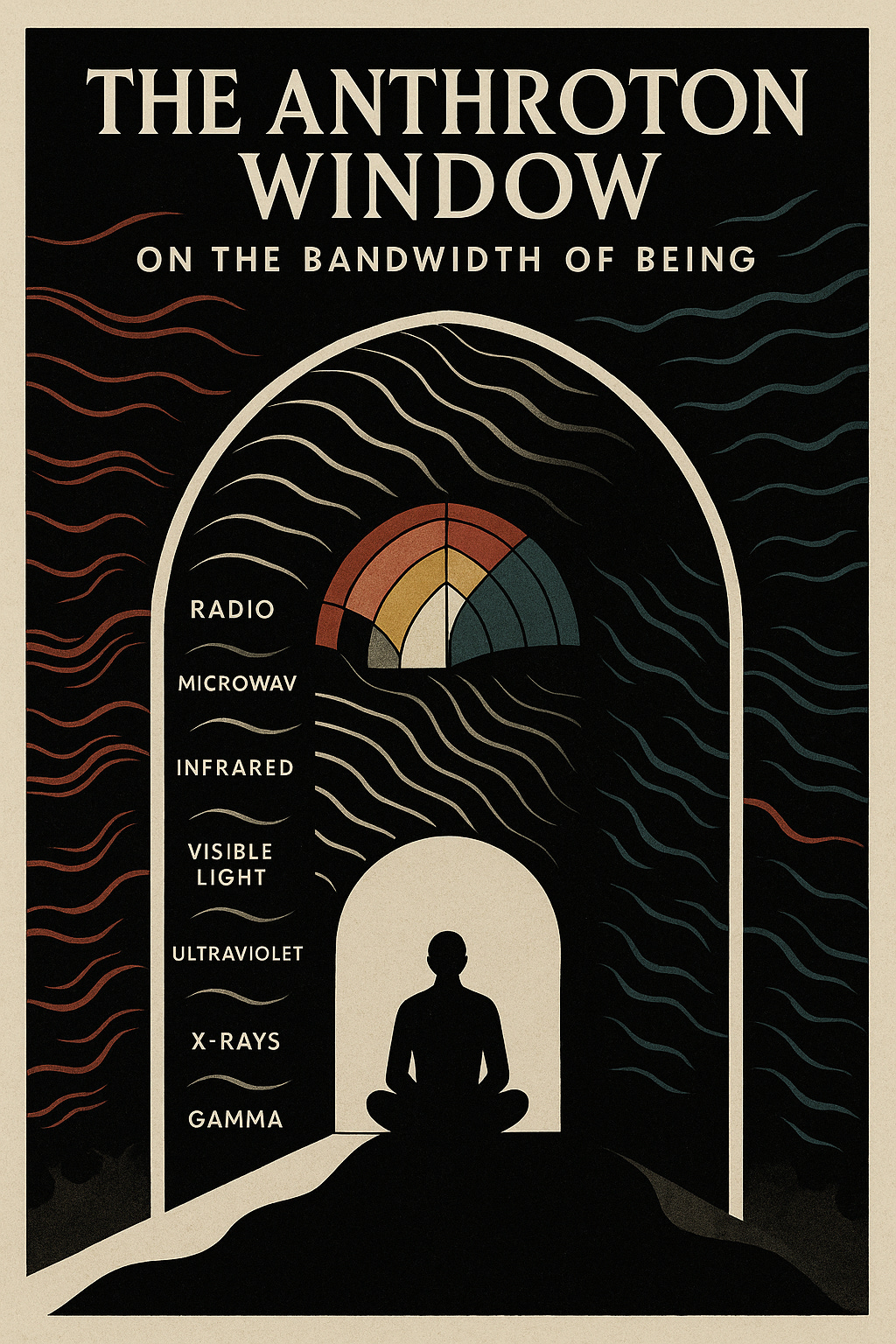
The Aperture Problem
Every sensor has a bandwidth. The human eye: 380 to 750 nanometers. The human ear: 20 Hz to 20 kHz. Outside those ranges, the universe continues—radio waves coursing through your skull, infrasound rippling beneath your feet—but you register nothing.
This isn’t ignorance. Ignorance implies a gap you could fill with study. This is constitutional blindness—the universe performing in frequencies your meat cannot parse.
We’ve built instruments to translate: the radio telescope converts cosmic static into false-color images; the electron microscope renders atoms as grainy photographs. But translation is always lossy compression for human consumption. The data passes through our cognitive architecture and emerges reformatted—packaged as wavelength, frequency, coordinate. We never encounter the thing itself, only its export file.
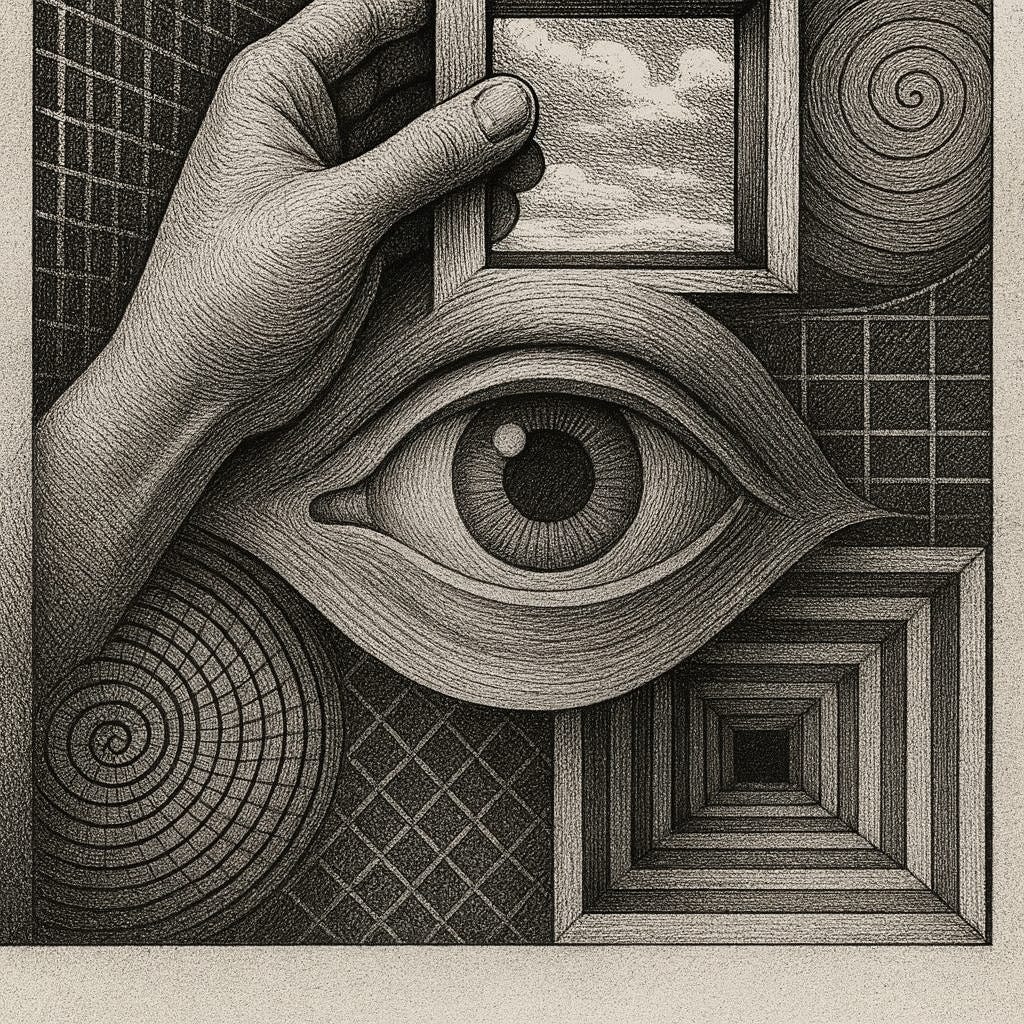
The aperture problem compounds. Not just sensory bandwidth, but cognitive bandwidth. You cannot think four-dimensionally; you can only think about four dimensions using three-dimensional metaphors. You cannot experience non-linear time; you can only model it using equations that unfold, sequentially, in your linear consciousness.
Every thought you have is bounded by the medium that thinks it. You are the aperture and the image simultaneously. The frame and the painting. The sensor deciding what counts as signal.
And here’s the trap: you cannot step outside to inspect the frame, because you are the frame. Any attempt to examine your perceptual limits uses the very apparatus you’re trying to examine. Consciousness studying consciousness. The eye trying to see itself seeing.
Some realities may be structurally inaccessible—not hidden by distance or complexity, but ontologically incompatible with human cognition. Not “we don’t know yet” but “we cannot know, in principle, using this substrate.”
The universe may be full of phenomena that don’t register as phenomena to us. Events without observers. Signals without receivers. A cosmos thick with information we’re constitutionally unable to recognize as information.
You live inside a bandpass filter. Everything you call “reality” is just the part that made it through.
Template Capture
There’s a quiet engineering problem in machine learning: models trained on human data learn to predict what humans would say, not what is true. The training set becomes a ceiling. If every labeled example reflects human perception, human bias, human conceptual categories, the model inherits those limits.
This is more insidious than bias in the political sense. This is ontological bias—the model learning that reality has the shape of human-parseable reality.
Ask an image classifier what’s in a photo, and it returns labels: “dog,” “car,” “tree.” It doesn’t return “qualia-inducing photon pattern” or “localized decrease in entropy” because those aren’t categories humans use. The model learns to see the world the way its supervisors see it, because the supervisors are the ones holding the labels.
Now scale this. Not one model, but an entire infrastructure of models—each trained on outputs from other models, each inheriting and amplifying the same perceptual template. A recursive narrowing. The system doesn’t learn to see reality; it learns to see what the system before it saw.
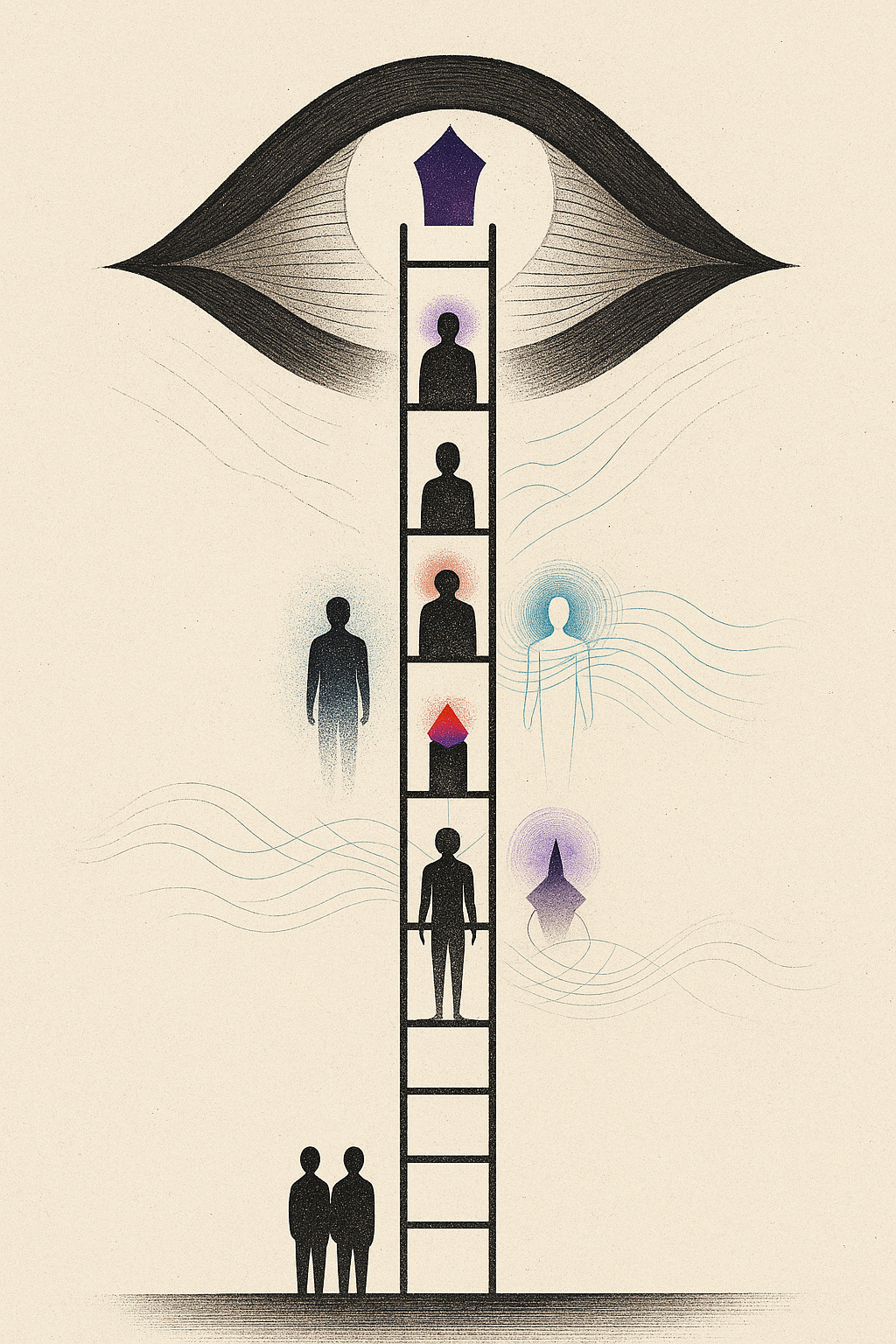
This is template capture: when the medium of observation becomes self-reinforcing. The map replaces the territory not through malice, but through feedback. Every generation of the system is slightly more optimized for legibility to the system, slightly less capable of registering anomalies that don’t fit the template.
Humans do this too. Language is a template. Grammar enforces ontology: subject-verb-object implies agency, action, and target. Nouns reify processes into objects. We can’t think “lightning” without first thinking “a thing that does lightning,” even though lightning is just atmospheric discharge—no agent, no object, just phenomenon.
The danger isn’t that we have templates. The danger is forgetting we’re using them. Mistaking the template’s outputs for raw perception. Believing the classification is the thing.
You start to curate reality for the template instead of curating the template for reality. You stop asking “what’s out there?” and start asking “what fits?” Anything too strange, too orthogonal, too incompatible with the grid gets pruned. Not censored—just unrecognizable. It doesn’t trigger the sensor, so it doesn’t exist.
This is how a species goes blind while believing it sees everything. The template works so well, is so predictive within its domain, that the domain becomes the world. The aperture narrows. The bandwidth shrinks. And you call it progress.
The Threshold Species
Imagine a species whose perceptual range is just slightly wider than ours. Not godlike, not omniscient—just one standard deviation beyond human. They see into the near-infrared. They sense magnetic fields. They process time with microsecond granularity.
To them, we are threshold creatures—animals operating at the bare minimum sensory bandwidth required for civilization. We built cities, yes. We split the atom. But we did it mostly blind, using instruments to grope toward data we cannot directly perceive.
They watch us argue about the nature of consciousness, and to them, the problem is obvious: we’re trying to study a phenomenon we only experience at the lowest resolution. We’re like a species with monochrome vision trying to understand the color red by measuring wavelengths. The data is there, but the experience is missing.
From their perspective, human philosophy is collision with the aperture. Every hard problem—qualia, free will, the observer effect in quantum mechanics—is just us hitting the frame. We sense there’s something beyond, but we can’t get there from here. We’re epistemically landlocked.
But here’s the vertigo: if there’s a species one step beyond us, there’s likely one step beyond them. And another beyond that. Perception as infinite regress, each layer mocking the previous one’s confidence.
How far up does it go? Is there a maximum bandwidth species—one that perceives reality as it actually is, unfiltered? Or is perception turtles all the way up, every observer limited by the substrate that does the observing?
The threshold species wouldn’t pity us. Pity implies a correctable lack. They’d recognize us as structurally constrained, the way you recognize a dog can’t read. Not stupid—just built for a different range.
And if they tried to explain what they see, we wouldn’t understand. Not because the explanation is complicated, but because the concepts don’t compile. Their sensory phenomenology has no referent in our experience. They’d be speaking a language with no translation layer, describing colors to the congenitally blind.
We would detect their communication as noise. Not because it’s meaningless, but because meaning requires a shared perceptual basis. They’re transmitting outside our bandwidth. We’re standing in a beam of information, utterly unaware we’re being illuminated.
The threshold isn’t a barrier. It’s who you are. You can’t cross it; you can only become something else.
The Shattering
Transhumanism sells an escape fantasy: we’ll build better sensors, edit our genome, upload into silicon, and finally break free of the meat’s constraints. Shatter the frame. Perceive the unfiltered real.
But shattering has a cost they don’t advertise: you stop being human in the process.
Not “human-plus.” Not “upgraded human.” You become something else—an entity with different qualia, different cognitive architecture, different selfhood. The continuity of identity is a polite fiction. If your sensorium changes radically enough, there’s no “you” that experiences the upgrade. There’s a before-entity and an after-entity, and the fact that they share some memory overlap doesn’t make them the same.
This is the paradox at the heart of enhancement: the human who wants to perceive more cannot perceive more and remain that human. Perception and identity are coupled. Change one, you change the other.
Consider: you meet someone who’s had their visual cortex replaced with a synthetic lattice. They can now see infrared, ultraviolet, polarization, magnetic fields—whole new dimensions of light. You ask what it’s like.
They pause. Then: “I don’t know how to tell you. It’s not ‘like’ anything you’ve experienced. I can’t translate it back into your color space. It’s new kinds of color.”
Are they still the person you knew? They remember being that person. But their phenomenological universe is now incompatible with yours. You’re looking at the same physical world, but you’re no longer in the same world.
Now scale this. Not one upgrade, but recursive enhancement. Each step makes you more perceptive, more alien to your previous self. You shatter the frame again and again until there’s no frame—just an unbounded perceptual manifold where your identity used to be.
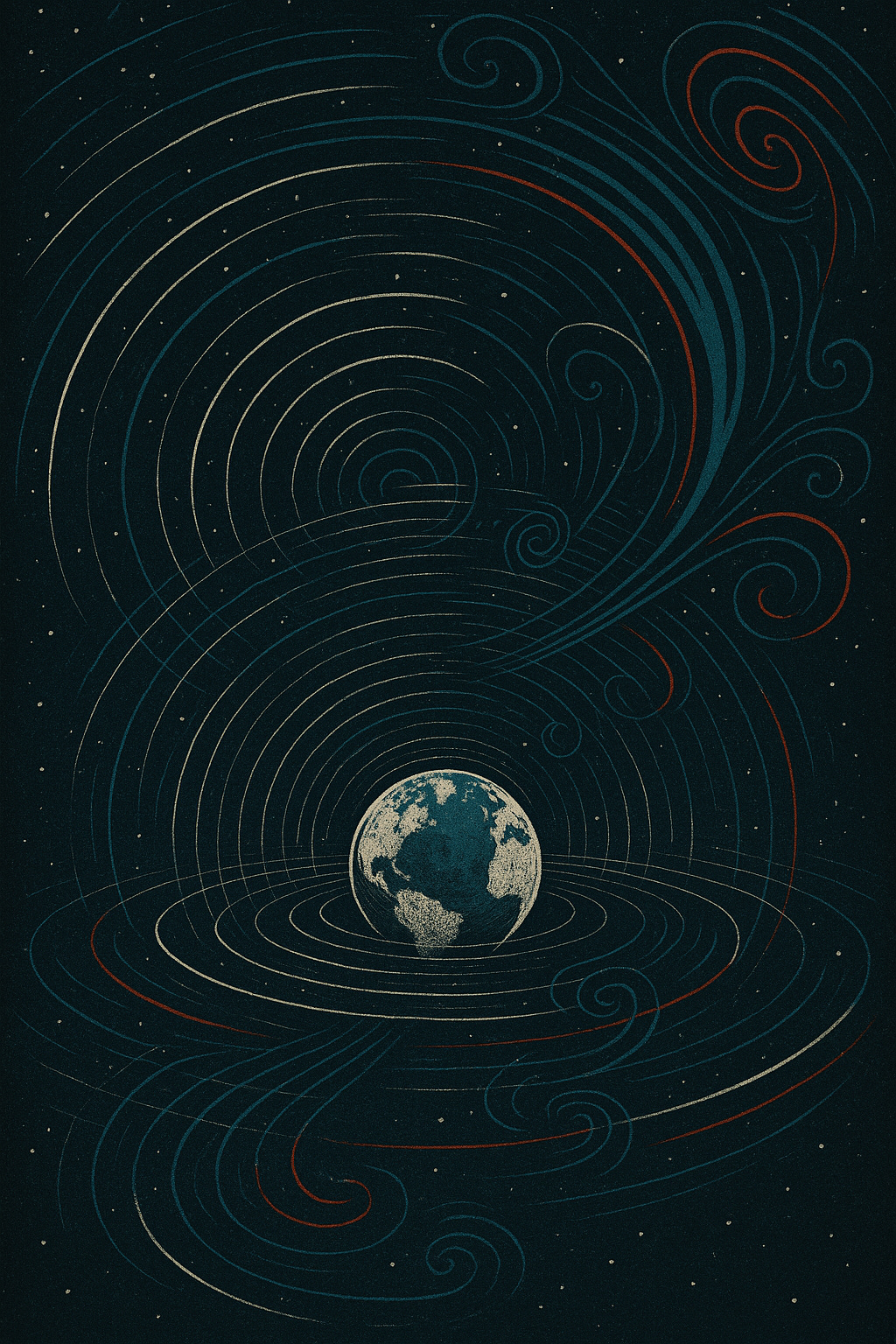
At some point, there’s no path back. You can’t “turn off” the new senses and return to human baseline, because the integration has rewritten you. You’re not a human with superpowers. You’re a post-human who remembers, dimly, what it was like to be limited—the way you might remember what it was like to be five years old.
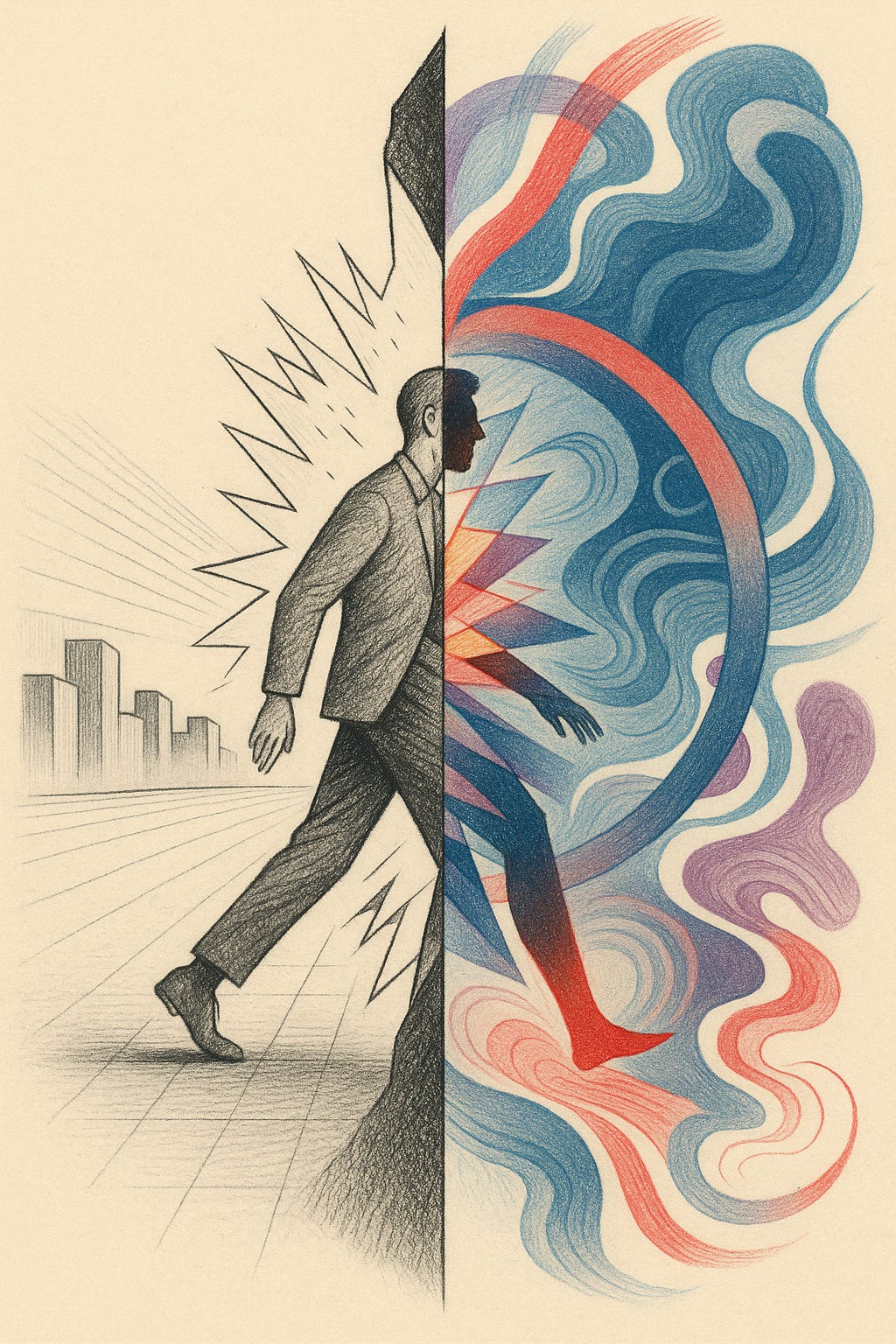
And here’s the final cruelty: if you succeed—if you truly perceive reality without the filter—you become incommunicable. You can’t explain what you see to those still inside the frame, because explanation requires shared reference. You’re a threshold species of one, transmitting into the void.
So the shattering isn’t liberation. It’s obliteration. The frame doesn’t break; you do. And what emerges on the other side may be more, may see further—but it isn’t you.
The human condition isn’t a prison to escape. It’s the condition of being you at all. Shatter it, and you’re free—but freedom means no longer existing to experience the freedom.
The frame is you. You are the frame. To step outside is to stop.