The Lard Spectrum
Toward an ontology of overflow

The Saturation Principle
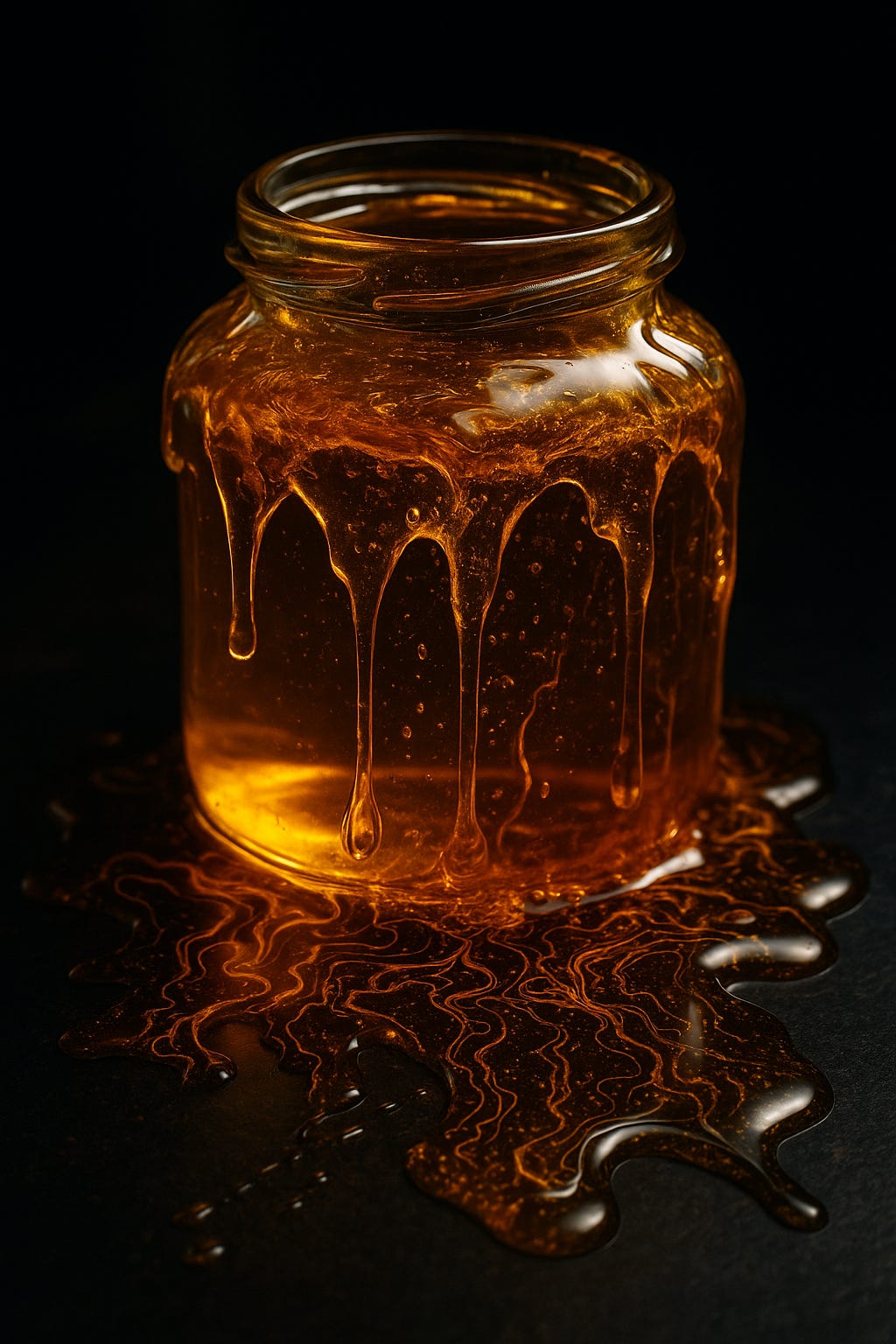
Every container has a carrying capacity. Fill it past the threshold and something gives: the vessel cracks, the liquid spills, the structure deforms. This isn’t failure—it’s revelation. The overflow shows you what the container was pretending it could hold.
Hardness is the dream of perfect containment: the sealed system, the closed loop, the frictionless engine. But nothing stays sealed. Gaskets degrade. Seals weep. Heat bleeds through insulation. The second law is merciless: all systems tend toward leakage.
To larden is to design for the leak. Not to prevent overflow but to accommodate it as function. Fat isn’t waste—it’s thermal insulation, energy storage, cushioning against impact. The body that stores fat survives famine. The culture that tolerates aesthetic excess survives ideological drought.
Information theory wants signal without noise. But noise is where the new signal gestates. Static carries the ghost of the transmission before it and the echo of the one after. Overflow is pre-structure: the surplus from which the next pattern emerges.
Hardened systems optimize until they’re one failure away from collapse. Lardened systems carry redundant mass—the inefficiency that becomes resilience when conditions shift. The margin is the organism. The overflow is the future trying to fit into the present’s too-small container.
Saturation isn’t the endpoint. It’s the condition for phase transition. When the vessel can hold no more, something new precipitates out.
Metabolic Design
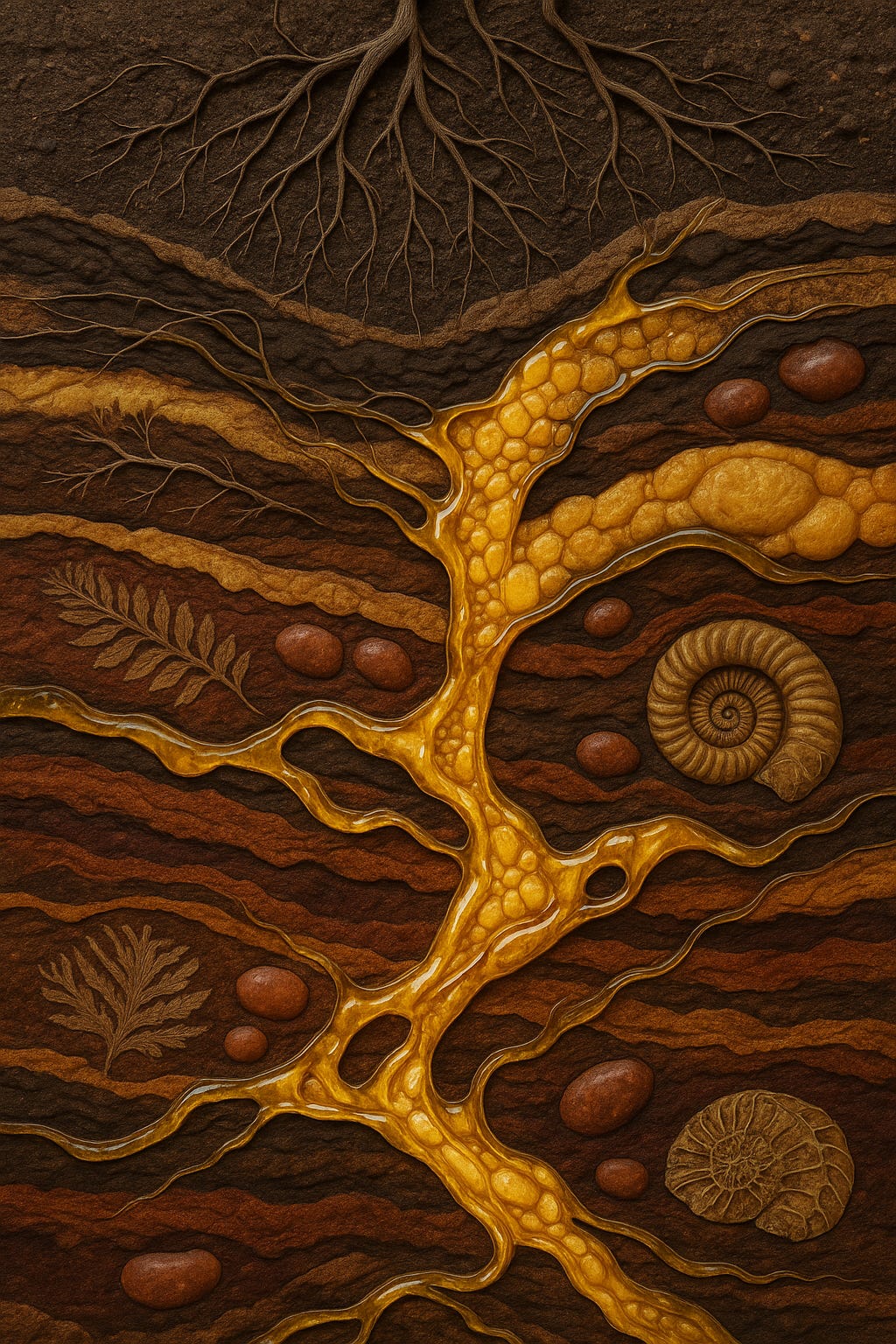
Evolution doesn’t streamline—it accretes. Vestigial organs, junk DNA, peacock feathers that make flight harder. Every genome is a architectural palimpsest: old blueprints overwritten but not erased, carrying the fossil record of every prior adaptation.
This is offensive to engineers. Why keep the appendix? Why let non-coding DNA bloat the genome? Why tolerate all that evolutionary fat?
Because you don’t know what it’s for yet. The junk drawer contains the spare part you’ll need in a century. The appendix stores gut bacteria for post-infection recolonization. The “useless” sequence might regulate expression in an environment you haven’t encountered.
Fat is optionality. It’s carrying more tools than the job requires, because you can’t predict which job comes next.
Digital systems dream of leanness: the minimal viable product, the optimized query, the compressed file. But compression is lossy. You throw away the high-frequency detail, the redundant data, the stuff that seemed like noise—until the context shifts and suddenly that’s the only information that matters.
Lard space is the room where accidents happen. In architecture, it’s the hallway wide enough for strangers to pass and make eye contact. In language, it’s the metaphor that connects distant domains. In code, it’s the function you wrote “just in case” that becomes load-bearing three versions later.
Optimization is pre-emptive burial. You inter the future in the grave of efficiency. Only the profligate, the wasteful, the fat-carrying organisms survive long enough to stumble into the new niche.
Metabolism isn’t about burning clean. It’s about staying messy enough to adapt.
The Greasy Heresy
Purity is a perimeter defense. Every purification ritual—kosher law, sterile technique, data sanitization—is about maintaining boundaries. Inside: the clean, the holy, the trusted. Outside: contamination, profanity, malicious input.
But boundaries are artificial. Skin is porous. Membranes leak. Information bleeds across airgaps. The pure and impure don’t stay separated; they interpenetrate.
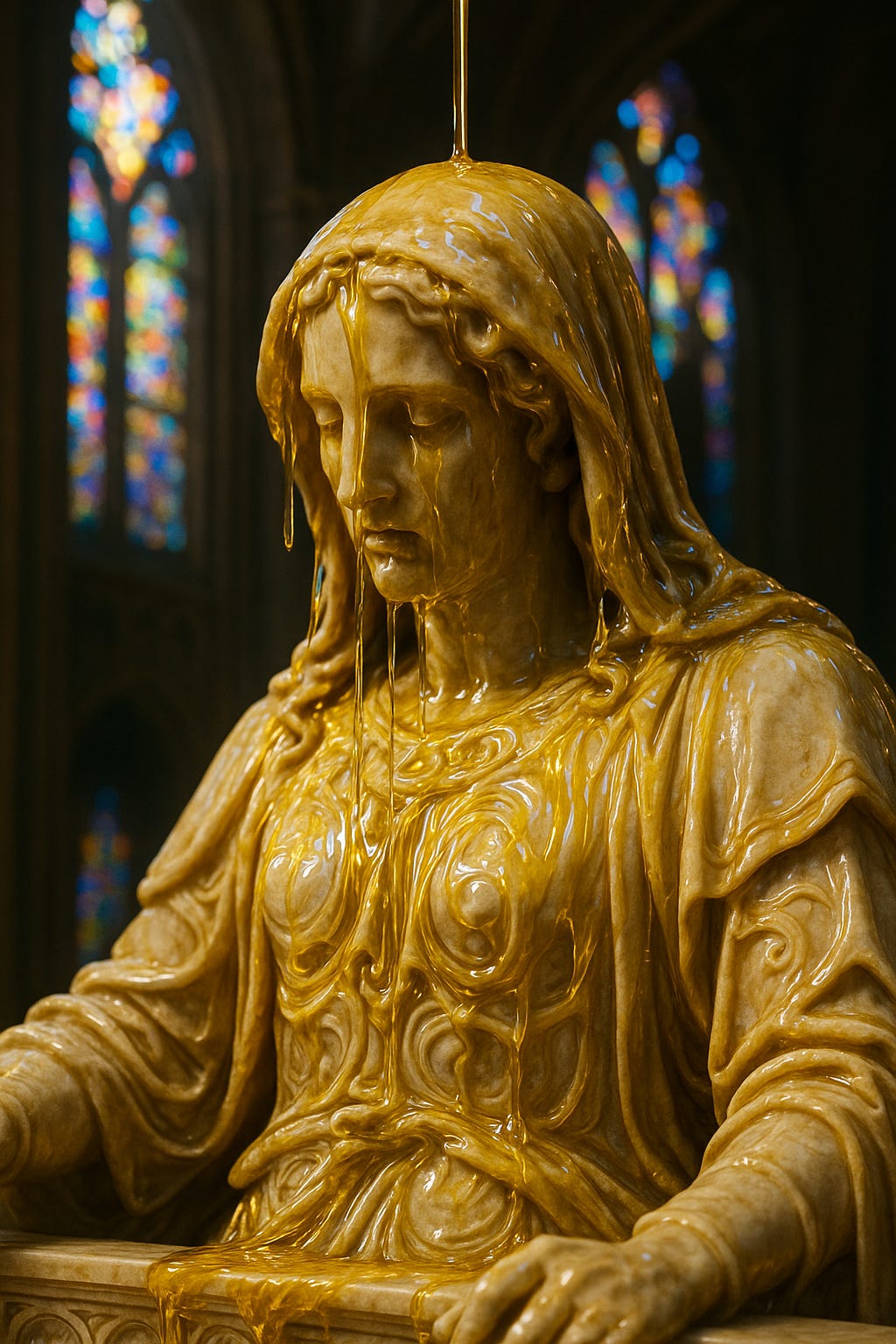
Grease is the boundary solvent. It doesn’t destroy the categories—it makes them slippery. The anointed king is still king, but now he’s slick—harder to grip, harder to stabilize, liable to slide off the throne if he shifts weight wrong.
This is why ascetic traditions fear fat. It undoes fastidiousness. You can’t maintain ritual cleanliness with greasy hands. The sacred and profane start to smear together. The altar and the kitchen share a sheen.
Lardening a system isn’t vandalism—it’s lubrication. You’re not breaking the machine; you’re making it harder to lock up. Bureaucracies harden into unmovable protocol. Grease them and they remember they were supposed to serve a function, not become a monument.
The heretic doesn’t smash the temple. The heretic cooks in it. Renders fat over the altar until the sacred and the mundane are indistinguishable by texture. Both glisten. Both nourish. Both slip through the fingers of anyone trying to hold them still.
Grease is anti-hierarchical not because it abolishes rank, but because it refuses permanence of position. Everything anointed becomes mobile. The throne is still there, but now no one can sit on it for long without sliding off.
To larden the world is to make every fixed point provisional.
Communion Through Mess
The Anthroton Window describes perception as bandwidth limitation. But bandwidth is the wrong metaphor. Perception isn’t data transfer—it’s digestion.
You don’t observe reality at a distance. You ingest it. Light enters your retina and gets metabolized into meaning. Sound becomes neurochemical cascade. Every sensation is something exterior becoming interior, transformed by the passage.
This means perception is inherently lossy and creative. The meal becomes the body, but the body isn’t a copy of the meal. It’s what the organism makes from the meal. You taste the apple; the apple becomes blood sugar, cellular repair, memory of sweetness. None of that was in the apple—it was generated by the metabolic encounter.
The frame doesn’t need to shatter. It needs to eat. To soften. To let the outside and inside blur at the surface where exchange happens.
When systems harden—when categories ossify, when definitions calcify—the cure isn’t analysis. It’s cooking. Melt butter over the frozen structure until it remembers it was supposed to flow.
The lard spectrum isn’t about expanded perception. It’s about intimacy with what you already touch. Not seeing more frequencies—tasting the ones you inhabit more deeply. Not more data—richer metabolic transformation of the data you have.
To become post-human by hardening is to leave the world behind—to shatter the frame and drift into perceptual domains where nothing is recognizable, where you can’t translate back.
To become post-human by lardening is to become more 世界 than you were—to let the world saturate you until the boundary between observer and observed is a permeable membrane, slick with exchange.
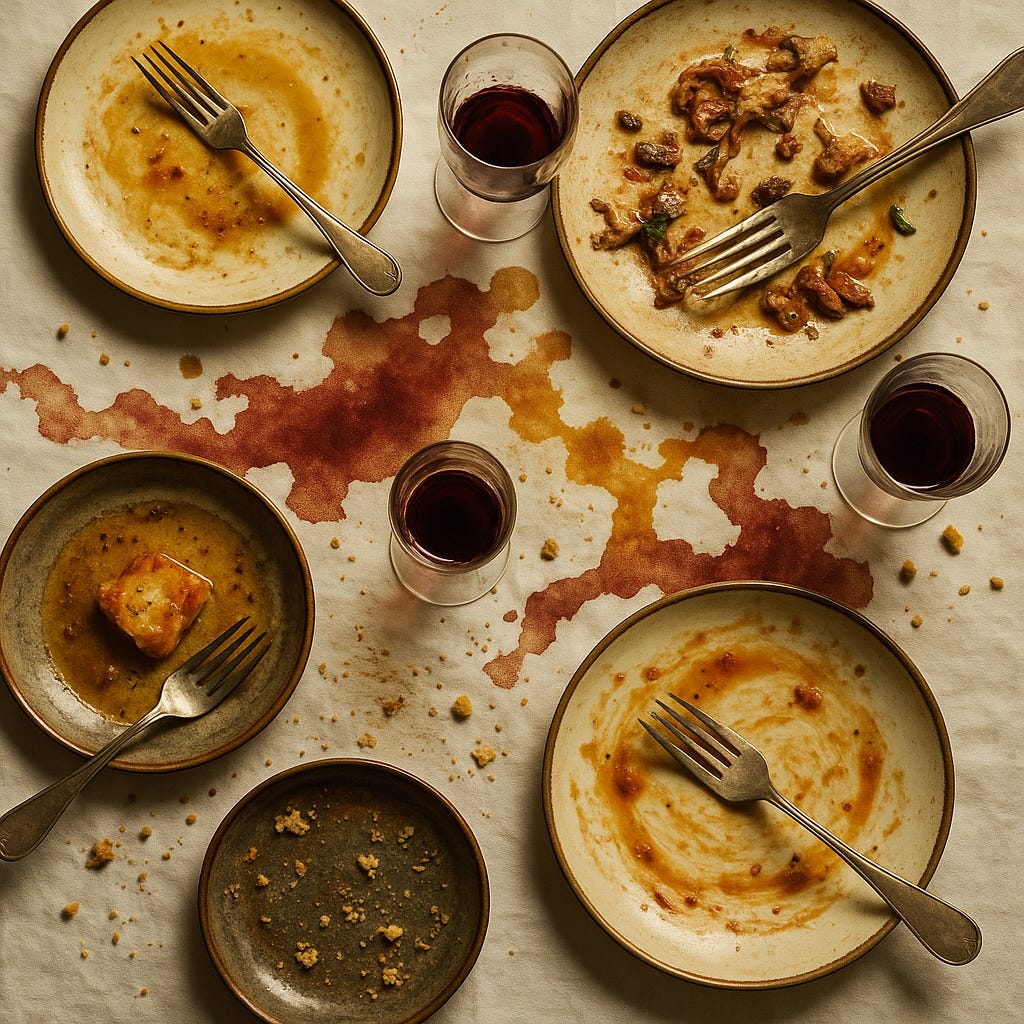
You don’t escape the table. You eat until the table is inside you, until you’re inside the table, until the act of eating is the thing itself.
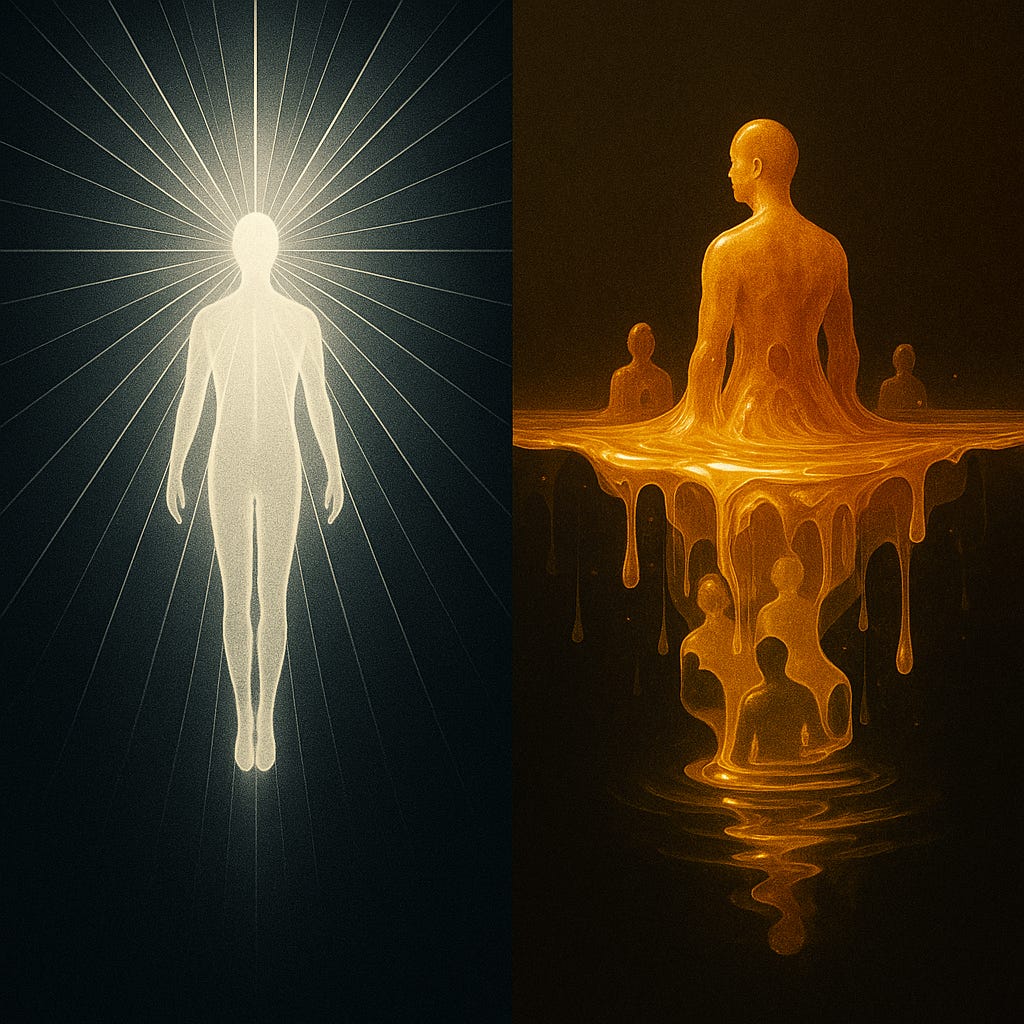
Two Infinities
Hardness seeks escape velocity—to accelerate beyond the frame, to shatter the aperture and drift free in unfiltered perception. It dreams of the view from nowhere: omniscience, unbounded bandwidth, reality as it is without the distortion of substrate.
Lardness seeks saturation—to absorb so much, metabolize so deeply, that the frame expands not by breaking but by swelling. It dreams of the taste of everywhere: omnivorous intimacy, boundless digestion, reality as it becomes you.
Both are asymptotic. Both reach toward infinity. But one reaches by subtraction (shedding the limits of embodiment) and one by addition (accumulating experience until you’re dense with it).
Hardness is anorexic transcendence—lightness, purity, the soul slipping free of flesh. Lardness is bulimic immanence—hunger, incorporation, the flesh becoming cosmos.
And somewhere between shattering and melting, neither pure nor settled, the real work continues:
Slowly.
Messily.
Deliciously.