The Multiverse
But Make It Petty

I was minding my own business, which is to say I was thinking about fifteen things at once while pretending to be present in a conversation about cars.
Someone mentioned Toyota with the kind of reverence usually reserved for saints or specialty coffee. You know the tone: capital-B Brand, capital-I Identity. I heard the letters, clocked “Toyota”, registered the cultural weight of Guys Who Know Cars, and my mouth went:

“Yeah, the, uh, FMJ whatever Toy-yoda thing.”
Not as a bit. Not as a targeted insult. Just a shrug in sentence form. My attention was busy elsewhere, and automotive taxonomy is not one of the sacred scrolls in my personal canon.
In a different reality, this is where they decide I’m dismissive.
That I “don’t respect people’s interests.”
That I’ve failed the vibe check of Car Guy Universe.
Meanwhile, in my reality, I’m just politely not installing a whole knowledge tree I’m never going to use. I’m not hostile; I’m just not reorienting my mental OS around trim levels.
Already: two timelines. Same moment, different worlds.
Now let’s take that small fracture line and walk it down the street.
Art Walk in the Petty Multiverse
I’m at an art walk with my mom. The kind of event that’s part street festival, part open-air personality test. You walk past booths and buskers and decide, over and over, what you’re going to see as “real art”, what you’re going to label “cute”, and what you’re going to pretend isn’t there so you don’t have to make eye contact.
We pass a man playing an accordion.
He’s not just playing; he’s inhabiting that tiny radius of space that musicians carve out in public. The sidewalk goes on being a sidewalk, but in this five-foot bubble, reality has a soundtrack.
I stop and drop money into his case. It’s a smooth motion: walk, pause, give. No ceremony. No performance. Just of course you tip the accordion guy. He offers me a collage poster he’s made as a thank-you. I take a moment, look over the options, pick one. Exchange complete.
There is also a dollar on the ground near the case. I do not register it.
(Author’s note: I could have picked it up after I dropped my money in, but that wasn’t where my head was in that particular moment in my meditation. My brain was tuned to “offer / receive / move on”, not “audit the sidewalk for loose currency.”)

We start walking away.
My internal reality: soft, present, satisfied. Gave money, accepted art, moved along the path. The story in my head is basically: nice dude, nice moment.
And then my mom says, “You missed.”
I follow her gaze.
She’s looking back at the case.
The musician is bending over, picking up the dollar.
Now we have a problem.
One Dollar, Three Universes
From one angle, it’s nothing: a bill on the ground, now picked up. Gravity, motor control, end of story.
From another angle, it’s an entire moral universe.
In my mom’s reality, the sequence goes like this:
I tried to tip the musician.
I physically missed his case.
The money hit the ground.
I walked away.
Interpretation: I messed up the basic mechanics of tipping and kept going. “You missed” is a factual correction with a side of we don’t do that.
In the musician’s possible reality (I don’t get to know which version he’s running):
Maybe he saw me aim for the case and miss.
Maybe he just saw someone drop a bill and leave.
Maybe he thinks nothing of it—street chaos, business as usual.
Or maybe he files it under wow, this guy just threw money on the ground near my case like I’m some NPC in a video game.
Interpretation ranges from “eh, people are weird” to “what an asshole.”
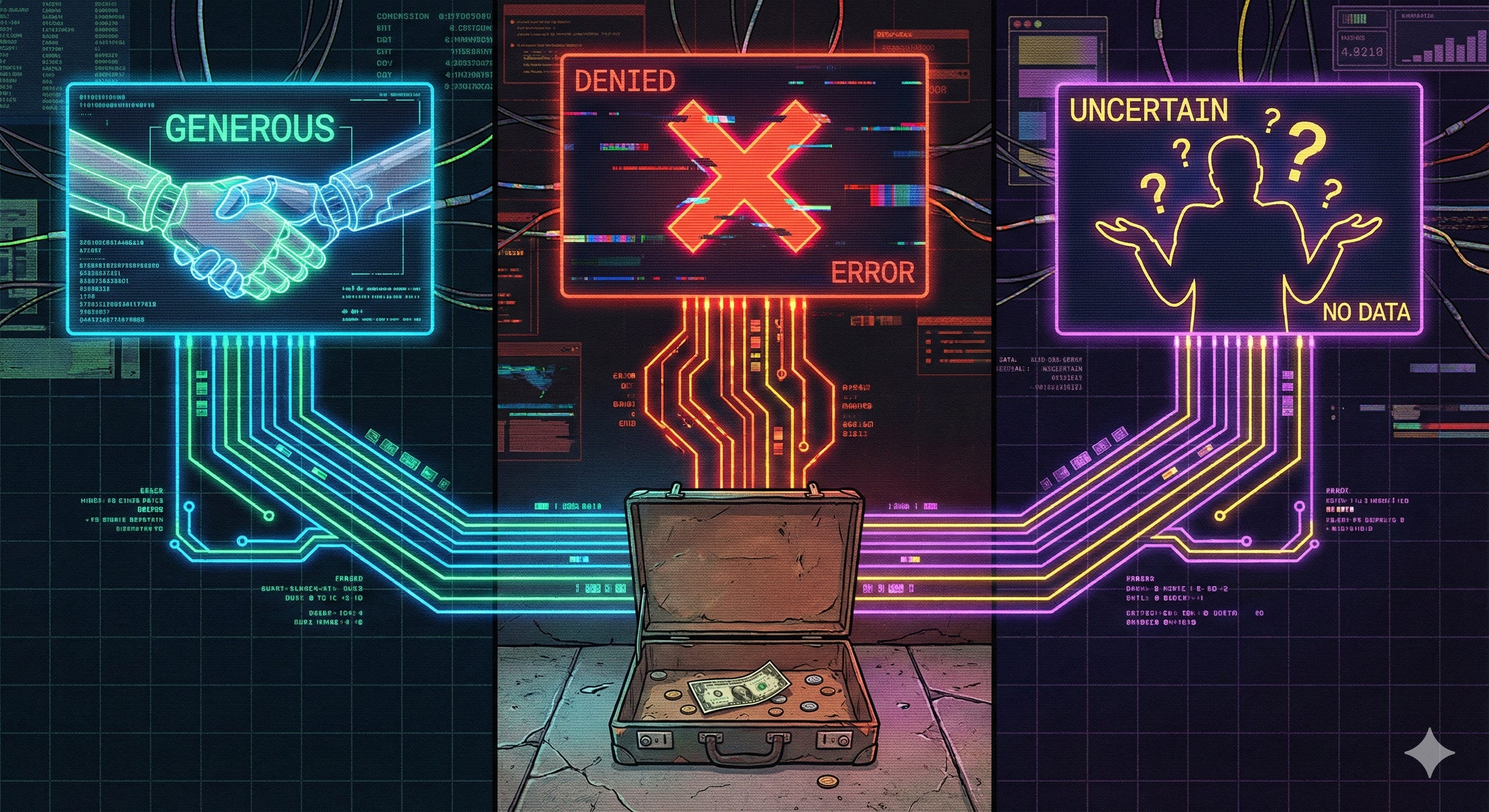
In my reality, I dropped money in the case. Full stop. My intention and my memory line up: I gave, he received, we closed the loop. The dollar on the ground wasn’t even in the shot list.
By the time my mom says “You missed”, the scene in my head is already over. Her correction feels like she’s describing an alternate cut of the same moment, one I didn’t see.
And that’s the petty multiverse right there:
Same sidewalk, same accordion, same dollar.
Three different universes, none of which can be fully proved to the others.
I told my mom what my experience of the moment had been as we rounded the corner, but explanation doesn’t erase perception. You can patch the narrative, but the first draft is still in there somewhere.
Did I, in his mind, symbolically toss money on the ground?
Did I look careless? Dismissive? Entitled?
I’ll never know.
He’ll never know what was happening in my head.
My mom will never not have seen what she saw.
Three people. One event. No single “real” version that everyone can agree on without swallowing their own experience.
Reality as a Petty Joint Venture
This is the part where philosophers like to wander in and start writing about phenomenology.
I am not going to do that.
We’re going to talk about it like it is: reality is a petty joint venture, and everyone thinks they’re the majority shareholder.
Most people operate like this:
Their perception = how it was
Their intention = what should be taken as true
Their story = the authoritative version
Anything that doesn’t line up is at best a misunderstanding and at worst an attack.
But the art walk scene exposes a more uncomfortable truth:
My intention was generous.
My mom’s perception was corrective.
The musician’s possible interpretation might be quietly negative.
All three are internally consistent. None can erase the others. They all keep existing in parallel, like tiny universes powered by one stray bill.

We love the big cinematic multiverse where Doctor Strange shatters timelines and cities fold in on themselves. We’re less excited about the multiverse where:
You think you made a harmless joke about an FJ Cruiser
Someone else hears “you’re mocking my identity”
A third person just hears random car noise and checks out entirely
Marvel gives you explosions. Real life gives you micro-aggressions, micro-misreads, and micro-moments no one ever talks about but that quietly shape how we feel about each other for years.
The multiverse is not just cosmic. It’s profoundly, painfully petty.
Petty Physics: How Universes Fork on Contact
Let’s outline the basic laws of petty multiverse mechanics:
Every moment contains more data than anyone can process.
Your attention is a flashlight, not stadium lighting. I aimed mine at “tip / poster / walking meditation.” The dollar was in the shadows.Interpretation outruns evidence.
By the time anyone has enough information to be “fair” they’ve already decided how they feel. Mom saw “missed.” Musician saw “bill on ground.” Feelings attach before facts finalize.Corrective explanations arrive too late.
Me, explaining after the corner: “Oh, I actually put money in, I swear.”
That’s not nothing, but it’s also not retroactive. It doesn’t overwrite her emotional snapshot of the scene. At best, it adds a footnote.Everyone assumes their slice of reality is the neutral one.
I’m thinking, I was being present.
She’s thinking, you were being careless.
He might be thinking, people are disrespectful.
No one is thinking, ah yes, my culturally conditioned interpretive apparatus has rendered its subjective judgment once again.Petty universes solidify in silence.
We don’t usually check in: “Hey accordion guy, what did you think just happened?”
Or: “Mom, how did that land for you emotionally?”
So the stories harden alone, in the dark, like cheap resin.
The result: a universe where everyone is genuinely confused why everyone else is so touchy and weird, while also being absolutely certain they themselves are reading things correctly.
Define “Reality” Bro
In the NASCAR piece, Richard Petty becomes the working definition of “petty bourgeois”—you don’t need the dictionary, you have a man in a cowboy hat doing 200 mph and living the contradiction.
Here, the art walk becomes the working definition of “no actual shared reality.”
You want a definition? It’s not a sentence in a textbook. It’s this:
Me dropping money in a case in what felt like a small meditative act
A dollar on the ground
A mom saying “you missed”
A musician bending down to pick it up
Three internal movies rolling simultaneously, none of them in 4K, all of them convinced they’re the canonical cut
Reality, as experienced by humans, is not “what really happened.” It’s which movie you’re watching and how seriously you take the director’s commentary in your own head.
Define “reality”, bro?
It’s the overlap between misread intentions and uncorrected assumptions, stabilized by the social norm of never actually talking about what just happened.
Villains, Everywhere, All at Once
The anxiety that hits after moments like this isn’t just “did I look dumb?”
It’s “am I now the villain in someone else’s narrative?”
Did the accordion player silently file me under:
people who throw money on the ground,
people who disrespect street musicians,
or just background NPCs with weird motor control?
It’s not that his judgment will ruin my life. It’s that there’s something existentially unsettling about the idea that your internal sense of coherence doesn’t travel with you. You can be at peace, in your head, and simultaneously a minor antagonist in someone else’s memory.

Swap out the details and this is half of human conflict:
You think you were being playful.
They think you were being cruel.
You think you were being direct.
They think you were being aggressive.
You think you forgot to follow up.
They think you ghosted them on purpose.
Everyone is a misunderstood protagonist, begging an invisible jury to understand their context.
Meanwhile, the jury is busy starring in their own trial.

This Could Be Us, but You’re in a Different Universe
All of this sounds abstract until you zoom back to the original car conversation.
Someone lives in a world where:
The FJ Cruiser is a personality trait
Correct nomenclature is respect
Knowing specs is part of adult competence
I live in a world where:
Automotive detail is background noise
The name is a loose pointer, not sacred text
The mind-space that would store trim levels is already overcrowded with other obsessions
We talk. Words move between us. Sound waves enter ears. But the realities behind those sounds never quite meet. At best, they brush fingertips.
The same happens with art, politics, love, class, religion, whatever. We keep trying to build shared reality on the thinnest possible surface: the words we say out loud. Underneath is a whole stack of universes, like a Jenga tower made of half-finished sentences and assumptions no one admits they’re making.
So What Do You Do with a Petty Multiverse?
This is not a self-help piece where I tell you to “communicate better” and “assume good intent” and “center empathy.”
We should probably do those things.
We also won’t, consistently.
The multiverse is not going away.
What you can do, maybe, is this:
Hold your own universe lightly.
You can know what you meant without insisting the accordion guy psychically downloads your intention.Assume you are, somewhere, someone’s minor villain.
Not because you’re evil, but because they caught a different angle of the moment and filled in the gaps with their own fears and stories.Recognize that most of reality happens at the edges.
Those little contacts—FJ Cruiser comments, stray dollars, passing interactions—are where universes brush past each other and generate sparks.
And when you catch yourself spiraling over whether someone thinks you’re an asshole for something you didn’t mean?
Remember: somewhere out there, you are the accordion guy.
You saw something fall, you picked it up, you wrote a whole story about it.
You never knew there was a poster, a meditation, a moment you didn’t see.
That’s the multiverse.
Not sci-fi. Not sacred geometry. Just three people, one dollar, and an infinite number of ways to be slightly wrong about each other forever.
This is great! I love all the examples and I can relate to the car one as I know absolutely nothing about auto nomenclature. I actually take peace in this knowledge because trying to convince someone to change their mind or accept my viewpoint is often exhausting and ultimately futile.
Take any conflict (politics is the most obvious). The reason this conflict exists is because one side believes the other side is bad, wrong, or misguided and if they could just convince them to "see the light," the world would be saved. But the other side believes the exact same thing, creating an impasse. Best to opt out of all that wasted energy and frustration.
Also I spent so much of my life trying to "prove myself," and in the example with your mom, if that was me, the old me would have gone blue in the face trying to convince her that she was wrong and that I wasn't some careless NPC. But now I recognize it doesn't matter, all that matters is how I interpret the event because that's the only thing I can control.
I used to feel uncomfortable with the idea of people talking about me behind my back or even thinking bad thoughts about me but now I realize for one there's not much I could do about it anyway so no point worrying and two I'm over here in my reality bubble so it doesn't really affect me unless I allow it to, I don't need to make it my business. Hopefully that makes sense.
This reminds me of when Anderson Cooper shit all over Kellyanne Conway for her alternate facts. I remember thinking that her point was actually kinda legit although I never said as much because she was dumb as a box of rocks. Nevertheless, a world of nearly infinite information sliced into the bits each of us can sense will always offer alternative facts for each perceiver. Be they petty or pretty or superhuman with capes. People in my job often compare it with chess as it requires thinking several steps ahead but I often think it is more about imagining each persons universe to better understand how they will react in it.
Anyway. Good to see something new from you. Fun thought experiment as always.